Fire penetration systems designed for your building.
Fire-resistant structures must meet fire resistance criteria across their entire surface, including linear joints between building elements and gaps. The fire resistance of fire-resistant structures must not be reduced by weakening or by non-closable openings and penetrations for distribution systems, installations, technical equipment or technological equipment. We provide professional installation, repair, and inspection of fire penetrations in accordance with applicable legislation and technical standards.
Types of firestop penetration:
Cables
They seal places where electrical installations (e.g., power or data cables) pass through fire-resistant structures. Fire-resistant sealants, collars, or graphite tapes are used, which expand at high temperatures and prevent the spread of fire through the opening.
Pipes (metal, plastic)
Pipe penetrations (water, heating, sewage) must be designed according to the pipe material. Plastic pipes melt in a fire, so fire-resistant collars that automatically seal the opening are most commonly used. Fire-resistant sealing systems and insulation are used for metal pipes to prevent overheating and the spread of fire through the structure.
Combined transfers (cables + pipes)
Penetrations where several types of installations are located in one opening – for example, cables, plastic and metal pipes. These penetrations are more difficult to seal properly and must be addressed with certified systems that guarantee the fire resistance of the entire opening. The right solution is crucial, especially in technical rooms and shafts.
Penetrations through various structures (wall, ceiling)
The type and method of sealing also depends on the structure through which the installations pass. Penetration through a fire partition (wall) and fire ceiling requires a different solution that takes into account the direction of fire spread and mechanical resistance. Fire-resistant sealants, boards, sleeves, and fillers are used, always according to the type of structure and the required fire resistance.

Designation of the fire penetrations
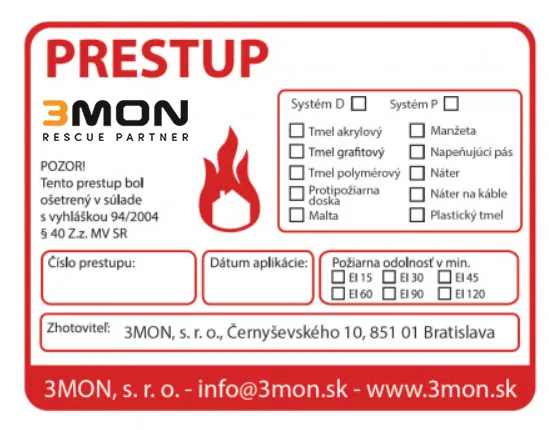
The penetration seal designation label shall be affixed to at least one side of the fire barrier so that it is always visible, legible, accessible and difficult to remove.
The penetration seal designation label shall contain the following information in particular:
- the word PRESTUP
- symbols of criteria and numerical value of fire resistance
- name of the penetration seal system
- month and year of manufacture of the penetration
- name and address of the manufacturer of the fire-resistant construction
Fireproof coating
The fireproof coating system is designed to increase the fire resistance of steel load-bearing structures in normal indoor and outdoor environments. Under the effect of fire, i.e. heat, the single-component fireproof coating expands and forms an insulating layer on the surface of the treated steel structure, which prevents the structure from overheating to a critical temperature for a specified (required) period of time.
Sealing plastic pipes
Fireproof sealing of plastic pipe penetrations can be achieved using built-in strips or fireproof sleeves. This prevents the spread of fire by interrupting the pressure in the pipe and filling the resulting opening with foamed graphite.
Fireproof cable seals
Fireproof seals are used to fill holes with cables, metal pipes up to 40 mm and construction gaps.
We work with industry leaders:




Frequently Asked Questions (FAQ)
Fire penetrations are points where installations (cables, pipes) pass through fire-resistant barriers. They must be sealed to prevent fire and smoke from spreading.
The process includes creating the opening, applying fire-resistant sealing material, and labeling it according to project documentation and applicable standards.
Firestop sealants, boards, collars, and pillows certified under EN 1366-3 are used.
Only certified fire protection companies. Inspections must be carried out by a fire safety technician and properly documented.
Fire penetrations should be inspected at least once a year, and additionally after any reconstruction, structural modifications, or changes to the utilities passing through the penetration.
This requirement follows from the need to maintain the fire resistance of building structures, as outlined in Act No. 314/2001 Coll. on Fire Protection and Decree No. 121/2002 Coll. of the Ministry of the Interior of the Slovak Republic, which regulates technical fire safety requirements for buildings, including the integrity and functionality of firestopping systems.