Firefighting is one of the most dangerous professions in the world. Every year, it claims thousands of injuries and dozens of lives. With the growing demands of interventions – from massive wildfires to complex industrial accidents – fire departments are seeking new solutions to keep their crews safe. And this is where robotics in firefighting comes into play.
Modern machines, from remotely controlled firefighting robots to reconnaissance drones, help reduce the risk of injuries, protect human lives, and increase operational efficiency.
Firefighter Safety – Why Is It Such a Challenge?
According to NFPA statistics, more than 63,000 firefighters were injured in the U.S. in 2023, an alarming number that highlights the dangers they face every day. Nearly one-third of these injuries occurred directly during fireground operations – the riskiest phase of their work. This stage is extremely dangerous because it combines high temperatures, limited visibility, toxic smoke, and the constant threat of structural collapse.
Injuries are not only a short-term issue – many have long-term consequences, affecting firefighters’ health and their ability to continue working. These facts emphasize the urgent need for innovative approaches and modern technologies in firefighting that can minimize risks during operations.
„When seconds matter, technology makes the difference.“
Simona Kalinovská (CEO 3MON)

Equally alarming are the fatality statistics: in 2024, 62 firefighters lost their lives in the line of duty, with the majority of fatal cases occurring during fireground operations.
The most common causes include:
burns and heat stress,
smoke or toxic gas inhalation,
chemical burns,
structural collapses or poor visibility.
Long-term health consequences are equally dangerous – research shows that firefighters have a significantly increased risk of lung cancer, bladder cancer, and mesothelioma.

How Robotics Helps Protect Firefighters
1. Remote Fire Suppression
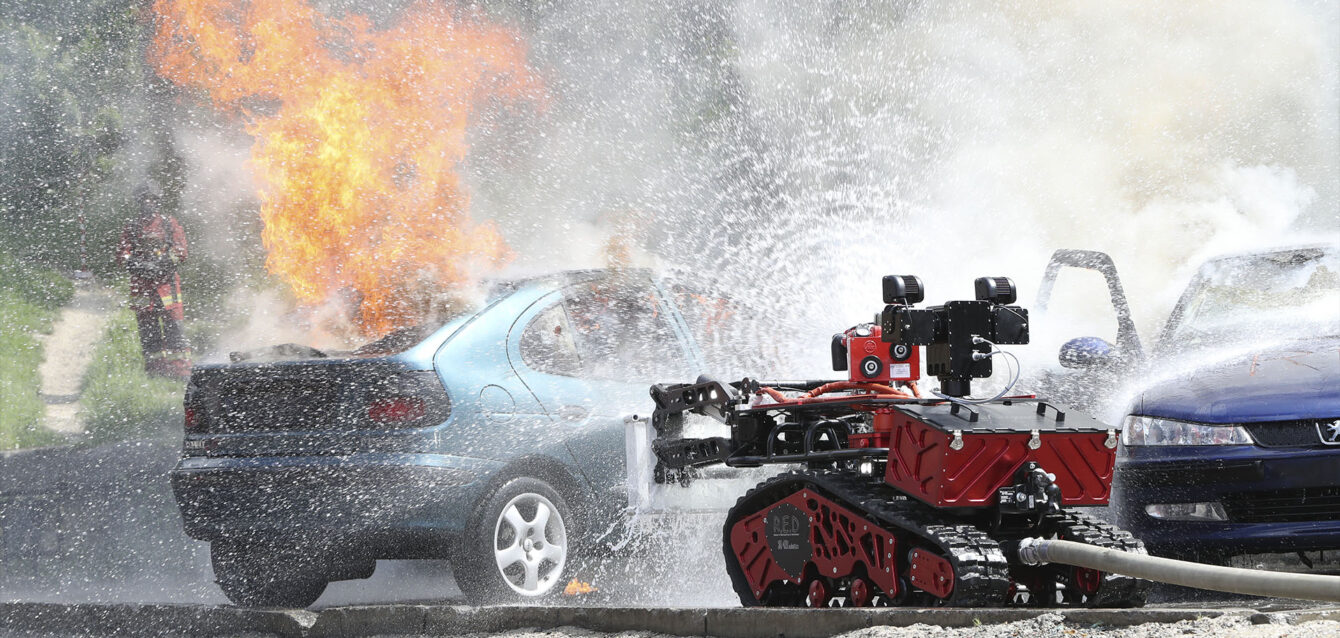
Robots such as Colossus or Rhyno Protect (by Shark Robotics) are designed for environments too dangerous for humans. They can approach the fire source and discharge water or foam from a safe distance of up to 1 km. They are highly mobile (fit through standard doors), powerful, and accurate in targeting the fire, which saves resources and minimizes collateral damage.
2. Monitoring and Data Collection
Before entering a burning structure, access to real-time information is critical. Robots equipped with thermal cameras, HD cameras, and modular sensor packages can detect gases, heat hotspots, or explosion risks. All data is transmitted to a rugged remote control station, giving commanders a clear picture of the situation and enabling fast, informed decision-making without exposing crews to danger.

3. Evacuation and Rescue
Some robotic platforms can be equipped with stretchers or rescue modules to evacuate injured civilians or firefighters from hazardous areas. This reduces the risk for responders who would otherwise have to move victims through smoke-filled or unstable structures.
4. Efficient Use of Resources
Robots can use up to 10 times less water than traditional firefighting methods by applying suppression precisely where it is needed. This reduces waste, conserves resources, and lowers environmental impact.
Case Study: Colossus at the Notre Dame Fire
When the Notre Dame Cathedral fire broke out in 2019, temperatures exceeded 900 °C, and the structure was at risk of collapse. Direct human intervention inside became impossible.
The Colossus robot played a critical role by cooling and stabilizing key areas, supporting the Paris Fire Brigade, and helping save both the towers and valuable relics.
Challenges and the Future of Robotics in Firefighting
While today’s firefighting robots already provide invaluable support, they are not fully autonomous and still rely on human operators. The future lies in artificial intelligence and human-robot collaboration. With machine learning, robots will be able to evaluate risks, adapt to changing conditions, and operate more independently.
Companies like Shark Robotics are already developing fully autonomous prototypes designed for confined spaces. The goal is not to replace firefighters but to provide them with a reliable partner capable of rapid intervention in life-threatening environments.
Technology protects those who protect us
Robotics in firefighting represents a major leap forward in both safety and efficiency. It is no longer just a futuristic concept but a real tool that saves lives and property every day. By operating in environments too dangerous for humans, these technologies enable firefighters to work more effectively, precisely, and – most importantly – more safely. Robots for firefighters will never replace the courage, expertise, and decision-making of human crews, but they provide a protective shield and take on the most dangerous tasks. The combination of human skill and machine precision marks a new era of firefighting – one where modern firefighting technologies stand side by side with those who protect us all.