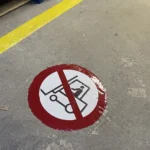
„Clear visual organization of the workplace improves orientation, strengthens safety habits, and creates a structured environment for everyone.“
Floor marking implementation without operational downtime
Fast UV Application Technology
For floor marking, we use advanced UV curing technology, which allows marking to be applied without interrupting operations and with immediate usability of the surface.
Advantages of UV technology:
- Instant curing after UV exposure
- Minimal operational impact – ideal even during full production
- Solvent‑free and odorless – clean and environmentally friendly process
- High chemical and mechanical resistance
- Application in temperatures from –25 °C to +35 °C
- Extremely long service life even under heavy load
Why Is Floor Marking Important?
In industrial environments, people, materials, and handling equipment are constantly moving. Clear visual marking helps prevent accidents, improves orientation, and supports workplace organization.
Floor marking helps to:
- reduce the risk of injuries and accidents,
- improve material flow and process efficiency,
- clearly define work zones, routes, and obstacles,
- meet legislative and occupational health & safety requirements,
- ensure order and discipline in the workplace.
Color Coding and Its Meaning
Floor marking is based on safety standards and uses a color system that provides employees with immediate visual guidance.
Yellow
Indicates traffic routes and the movement of handling equipment.
White
Indicates workstations and neutral areas.
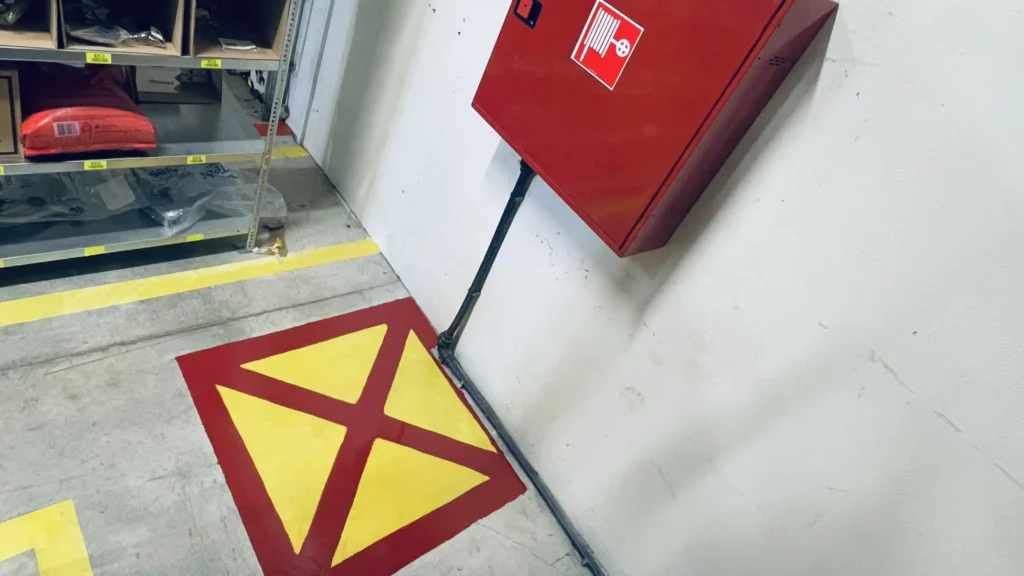
Red
Indicates fire‑fighting equipment and prohibited areas.
Green
Indicates safe zones and emergency escape routes.
Blue
Indicates parking spaces and material positions.
Black–Yellow
Indicates hazardous areas, edges, and obstacles.
Where Does Floor Marking Help?
- manufacturing and assembly facilities
- logistics centers
- warehouse halls
- transport and handling routes
- loading ramps
- service workplaces
- parking and movement zones
How the Implementation Works
1. Inspection and operational analysis
We analyze the actual movement of people, equipment, and material flow.
4. Implementation without downtime
Thanks to UV technology, marking is applied during full operation.
2. Solution design for certain areas
We propose a logical, safe, and legally compliant floor marking layout.
5. Handover and recommendations
Advices for maintenance, inspection, and further safety improvements.
3. Implementation without downtime
Thanks to UV technology, marking is applied during full operation.
3MON = Technology, innovation, and solutions for real practice
Frequently Asked Questions (FAQ)
Floor marking is a visual safety and guidance system applied directly to the floor. It is used to mark walkways, work zones, hazardous areas, storage spaces, and emergency routes. The main goal is to improve workplace safety, orientation, and the overall efficiency of operations.
Floor marking is commonly used in production plants, warehouses, logistics centers, parking areas, service facilities, hospitals, and retail spaces. It is especially important in environments with frequent movement of people, forklifts, and machinery.
Floor marking uses standardized color codes to ensure immediate understanding:
- Yellow – traffic routes and handling equipment paths
- White – workstations and neutral areas
- Red – fire‑fighting equipment and prohibited areas
- Green – safe zones and emergency escape routes
- Blue – parking spaces and material locations
- Black–Yellow – hazardous zones, edges, and obstacles
Correct color usage improves clarity and compliance with safety regulations.
Floor marking can be applied using special industrial paints, self‑adhesive floor tapes, or durable marking symbols. The choice of material depends on floor type, traffic load, and required durability, especially in high‑stress industrial environments.
In many cases, yes. Although floor marking may not always be explicitly mandated, employers are legally required to provide a safe working environment. Clear marking of walkways, hazards, and emergency routes is an essential part of occupational health and safety compliance.